
In the high-pressure environment of top-tier football, the conversation surrounding a manager’s job security can shift from solid ground to thin ice in the space of a single ninety-minute match. Following a disappointing home defeat against Brentford, Newcastle United finds itself navigating one of the most turbulent periods since the takeover by the Public Investment Fund (PIF).
Despite the rising volume of criticism from sections of the St. James’ Park faithful, the stance from the club’s hierarchy remains remarkably steady. Rather than looking for a scapegoat, the decision-makers at Newcastle are viewing the current slump through a lens of shared accountability.
This philosophy of collective responsibility means that the burden of the club’s 12th-place standing does not fall solely on Eddie Howe’s shoulders. Sporting director Ross Wilson and CEO David Hopkinson are reportedly prepared to share the weight of recent failures.
The defeat to Brentford was the club’s tenth loss of the Premier League season and their third consecutive defeat in the top flight, a statistic that would usually spell disaster for most managers.

However, the leadership at Newcastle appears determined to avoid knee-jerk reactions, preferring to analyze the season as a long-term project rather than a series of weekly crises.
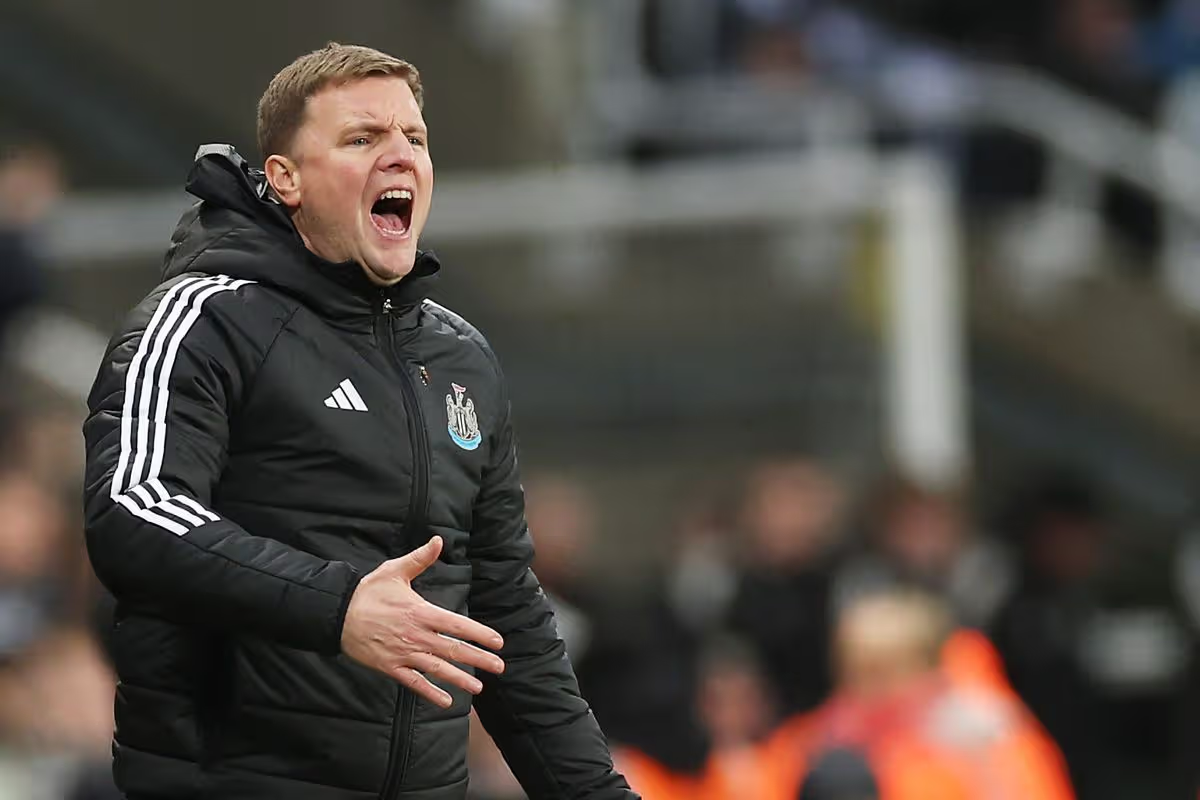
The scene at St. James’ Park on Saturday night was a sobering one. As the final whistle blew, the famous stadium was filled with the sound of boos a rare and stinging rebuke for a manager who has largely enjoyed a hero’s status since arriving in the North East.
Howe, however, displayed his trademark composure when addressing the reaction. He noted that he has no issue with the fans expressing their frustration, acknowledging that the supporters are simply reacting to the product delivered on the pitch.
His belief is simple: if the team performs, the “12th man” will return with full voice. He does not fear losing the crowd permanently; he sees the tension as a natural byproduct of underperformance that only results can fix.
The strategic patience shown by the board is bolstered by the fact that Newcastle is still competing on multiple fronts. While the Premier League form is concerning, the club remains active in both the Champions League and the FA Cup.
This creates a critical timeline for the coming weeks. A two-legged European tie against Qarabag offers a golden opportunity to reach the last 16, a milestone that would significantly brighten the season’s outlook. Similarly, an upcoming FA Cup clash against Aston Villa is viewed by Howe and his staff as a winnable game that could act as a turning point for the squad’s confidence.
Behind the scenes, the messaging has been consistent. David Hopkinson recently reaffirmed his stance, describing Howe as an “extraordinary” manager and insisting that he has the total support of everyone at the club.
Because Hopkinson serves as the primary advisor to the PIF on major sporting decisions, his public backing is a mirror of the sentiment held in Saudi Arabia. For the time being, the owners are not looking for a change.
There is also the practical matter of finances; a mid-season managerial change would involve a massive compensation package, something the club is keen to avoid as they navigate strict financial regulations.
However, the landscape of football is notoriously fickle. While the board’s support is currently firm, it is not unconditional. The mood could shift rapidly if the “triple threat” of competitions becomes a singular focus on league survival.
If Newcastle were to exit both the FA Cup and the Champions League in quick succession, the public pressure might become too heavy for even the most patient owners to ignore. For now, the job remains Howe’s to lose, but the margin for error has shrunk to almost nothing.
The emotional toll of this period was visible during Howe’s most recent press conference. Observers noted a “glazed” look in his eyes as he sat before the media, struggling to find the words to describe the weight of the situation. In a moment of raw honesty, he admitted to being angry and annoyed with himself.
He refused to deflect blame onto his players or the board, insisting on taking full accountability for the tactical lapses and the lack of defensive structure seen in recent games. This level of self-reflection is one of the reasons the board remains so loyal; they see a manager who is deeply invested in solving the problem rather than making excuses.
As the team prepares for a high-stakes trip to London to face Tottenham, the objective is clear. The “extra time” granted by the board must be used to produce a tangible shift in momentum. The upcoming Monday morning media session will be another test of Howe’s resolve as he prepares his squad for a match that could either begin a climb back up the table or deepen the sense of crisis.
For Eddie Howe and Newcastle United, the goal is no longer just about playing attractive football; it is about survival, stability, and proving that the shared responsibility of the board is a gamble that will eventually pay off.