
The pursuit of elite status in modern football is often a battle fought as much in the boardroom as it is on the pitch. For Newcastle United, the reality of this struggle was recently brought into sharp focus following the release of the Deloitte Money League rankings.
Despite the club’s massive ambitions and the backing of wealthy owners, the Magpies slipped two places to 17th in the global revenue standings. With a revenue pool of £335 million, the club finds itself in a difficult position, trailing significantly behind the financial powerhouses of the Premier League.
When compared to the £702 million generated by Liverpool or the nearly £700 million seen at Manchester City and Arsenal, the gap becomes a glaring obstacle for manager Eddie Howe.
The vision of a “Saudi super stadium” frequently teased through sleek concept images shared by fans online represents the ultimate dream for increasing the club’s Profit and Sustainability (PSR) threshold.
However, Eddie Howe is a pragmatist who understands that while a shiny new arena might be the long-term answer to these financial restrictions, his current priority is maximizing the legendary atmosphere of St. James’ Park.
As the team prepares for a crucial encounter against Aston Villa, the manager is leaning heavily on the “fortress” mentality that has served the club so well since his arrival.
Howe’s perspective is shaped by the electric atmosphere he witnessed during a recent Champions League victory over PSV Eindhoven. He described that night as a return to the truly special European evenings that have come to define the club’s identity.
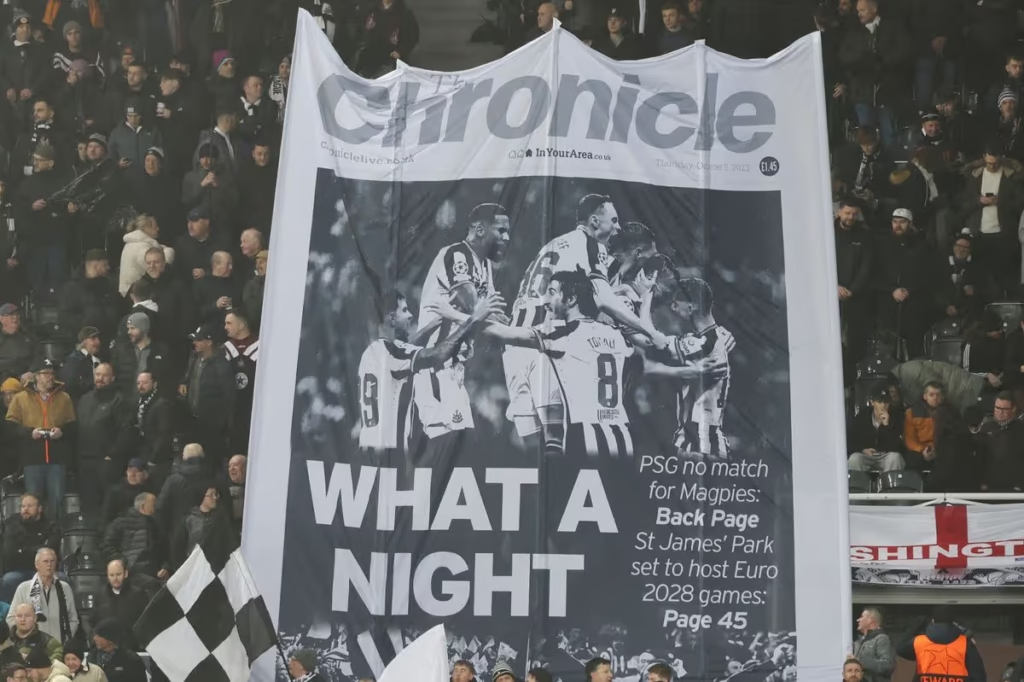
For Howe, the connection between the 50,000 passionate supporters and the players is a weapon that no amount of money can immediately buy. He remains deeply thankful for the energy the crowd provides, seeing it as an essential tool in his quest to secure another top-five finish and return to Europe’s top table.
Despite his primary focus on tactics, training, and player recruitment, Howe has increasingly had to think like an accountant. He acknowledged that the recent financial figures make for “interesting reading” and serve as a wake-up call for everyone involved with the club.
He understands that for Newcastle to consistently compete with the “Big Six,” the income generated through matchday revenue and commercial deals must skyrocket. While the club’s CEO, David Hopkinson, has indicated that Newcastle will remain at their current home for at least the next few years especially with St. James’ Park set to host games for Euro 2028—the pressure to expand or relocate will only grow.
Howe is well aware that the club’s supporters might be weary of hearing about financial restrictions and revenue building, but he insists that these are factual hurdles that cannot be ignored. Much work is happening behind the scenes to bridge the financial divide, but in the meantime, Howe’s philosophy remains centered on outperforming his resources.
He believes in the power of overachievement stretching every ounce of effort from his existing squad regardless of the budget available for new signings. This mindset isn’t just a management cliché; it is a belief system forged in the fires of his early career.
Long before he was managing international stars like Bruno Guimarães or Anthony Gordon, Howe was fighting for survival at Bournemouth. He often tells the story of his first season as a manager, where he had to spend his own money just to buy basic training equipment.
During that time, the Cherries were on the brink of falling out of the professional leagues and into the non-league wilderness. When a transfer embargo prevented him from signing new players, he managed to secure promotion with the exact same group of men.
That experience taught him a fundamental lesson: while money becomes more important the higher you climb, the core of success always comes down to getting the absolute best out of the human beings under your control.
This background gives Howe a unique resilience. He doesn’t look at the massive revenue figures of Liverpool or Arsenal with envy, but rather as a benchmark for where Newcastle needs to go. He is reluctant to put a ceiling on what his team can achieve this season, but he is committed to pushing for the absolute maximum.
The upcoming match against Aston Villa is a perfect example of the challenge at hand. To move back into the hunt for a Champions League spot, the Magpies must prove they can overcome their financial “underdog” status through tactical superiorly and the sheer vocal power of their home ground.
Ultimately, the Saudi super stadium remains a tantalizing “what if” for the future. It represents the potential for Newcastle to finally sit at the top of the Money League and enjoy the same spending power as the world’s biggest clubs.
But for now, the reality is a 130-year-old stadium in the heart of a city that lives and breathes for its team. Howe loves being involved at St. James’ Park and views it as an iconic place to play football. He knows that as long as the fans continue to provide the kind of atmosphere seen against PSV, Newcastle will always have a fighting chance, regardless of the numbers on a balance sheet.